
What Is Digital Marketing? A Complete Beginner’s Guide to Getting Started in 2026
Have you ever searched for a product on Google, watched a review on YouTube, and then noticed the same brand appearing in your Instagram feed?
Or perhaps you’ve discovered a small business through a social media post, visited its website, and eventually purchased something from it.
These experiences are part of what is digital marketing.
Today, a business doesn’t necessarily need a huge showroom, a television advertisement, or a large marketing team to reach potential customers. A small shop can showcase its products online, a student can build an audience around a skill, and a freelancer can find clients through a website or social media.
But digital marketing isn’t simply about posting on Instagram, making Reels, or running advertisements. It’s about understanding people, communicating value, choosing the right platforms, and helping potential customers discover what you offer.
If you’re a student exploring career options, someone interested in freelancing, a content creator, or a business owner trying to grow online, learning digital marketing can be a useful investment in your skills.
The best part? You don’t need to master every tool or understand every marketing technique before getting started.
In this guide, we’ll break everything down into simple, practical sections. You’ll learn what digital marketing means, how it works, the different types, which tools beginners can use, and how to start practising even if you have no previous experience.
What Is Digital Marketing?
Digital marketing is the process of promoting a business, product, service, or brand through digital channels, including websites, search engines, social media, email, and online advertising platforms. (What Is Digital Marketing)
In simple words, it means using digital technology to connect with people who might be interested in what you offer.
Let’s understand this with an example.
Imagine someone starts a small business selling traditional food products in Madhya Pradesh. The products are good, the packaging looks attractive, and customers who try them are happy. However, most people outside the local area have never heard of the brand.
The owner decides to create an Instagram page, publish product photographs, share videos about how the products are prepared, and build a website where customers can place orders.
The owner also creates a Google Business Profile to help nearby customers discover the business through relevant local searches.
Over time, the brand begins receiving enquiries from people who discovered it online.
The website, social media content, search visibility, and other promotional activities are all parts of a digital marketing strategy.
Notice something important: the business hasn’t necessarily changed its products. It has found additional ways to reach people who might want to buy them.
Digital marketing isn’t limited to large companies. Small businesses, independent creators, educational websites, freelancers, and local service providers can all use digital channels.(What Is Digital Marketing)
What Is Digital Marketing the Main Goal ?
The goal depends on what a business wants to achieve.
For example:
- A new website might want to attract more relevant visitors.
- A local restaurant might want to receive more enquiries and reservations.
- An online store might want to increase product sales.
- An educational creator might want to grow an audience and attract subscribers.
- A freelancer might want to find potential clients.
- An established company might want to maintain relationships with existing customers.
These goals are related, but they aren’t identical.
A campaign that attracts thousands of visitors may still be unsuccessful if those visitors have no interest in the business. Similarly, a social media post with fewer views could be valuable if it reaches the right people and generates genuine enquiries.
That’s why good marketing starts with a clear objective rather than simply trying to collect more views, likes, or followers.

Why Has Digital Marketing Become So Important?
Think about how you usually decide whether to purchase something online.
You might search Google for reviews, watch a product demonstration, compare prices across websites, or ask someone for a recommendation.
Businesses need ways to become visible during this process. Digital marketing provides several opportunities to introduce a brand, answer questions, and communicate with potential customers.(What Is Digital Marketing)
1. Reach People Beyond Your Local Area
A physical shop generally depends on people who can visit its location, although delivery businesses can serve customers farther away.
A website allows a business to introduce its products or services to people in different cities and regions.
For example, a small Indian brand selling handmade products could create an online store and use content marketing to reach people who are interested in those products.
A website can make a business accessible to a wider audience, although reaching customers in other regions also requires suitable delivery, pricing, customer support, and business operations.
2. Start With a Flexible Budget
Not every digital marketing activity requires paid advertising.
You can start learning through blog writing, social media content, educational videos, website improvements, and other activities that don’t necessarily require an advertising budget.
These activities still demand time, effort, and practice. Free methods also don’t guarantee traffic or sales.
However, they provide an accessible way to develop skills before investing money in paid campaigns.
For a beginner or small business owner, this flexibility can be valuable.
3. Understand What Is Working
Imagine spending money on an advertisement without knowing whether anyone clicked it, visited your website, or purchased your product.
It would be difficult to decide whether the campaign was worth continuing.
Digital analytics tools can help businesses measure website visits, clicks, enquiries, and purchases when appropriate tracking is configured.
This information can help you compare different approaches and identify opportunities for improvement.
The numbers still need interpretation. More traffic doesn’t automatically mean more sales, and a high click-through rate doesn’t guarantee that a campaign is profitable.
4. Build Relationships With Customers
Marketing doesn’t have to stop when someone buys a product.
Businesses can share helpful guides, answer customer questions, send newsletters to subscribers, and provide information about new products or services.
These interactions help people become more familiar with a brand and decide whether they want to engage with it again.
Over time, helpful communication and a good customer experience can contribute to trust and repeat business.(What Is Digital Marketing)
5. Develop Skills That Are Useful Across Different Careers
Digital marketing knowledge can help people working in business, content creation, communications, website design, and many other fields.
Even if you don’t become a full-time digital marketer, understanding how websites attract visitors and how online campaigns work can help you promote your own projects.
For students, these skills can also provide a practical way to explore career interests before choosing a specialization.(What Is Digital Marketing)
How Does Digital Marketing Actually Work?
Digital marketing becomes easier to understand when you look at the process from the customer’s perspective.
Imagine that you’ve started selling handmade notebooks online. The products are ready, but hardly anyone knows your brand exists.
Simply creating a website won’t necessarily bring visitors. You need to help people discover the website, understand your products, and decide whether they want to buy.
Here’s how the process might work. (What Is Digital Marketing)
Step 1: Understand Your Audience
Start by identifying the people who might be interested in your product or service.
Are they students looking for study planners? Professionals who enjoy journaling? People searching for personalized gifts?
Different customers may care about different things. Students might prioritize affordability and page layouts, while gift buyers might focus on customization and packaging.
Understanding these differences helps you create more relevant content and clearer marketing messages. (What Is Digital Marketing)
Step 2: Choose the Right Platforms
Once you understand your audience, decide where you can realistically reach them.
You might build a website, publish videos on Instagram, write blog articles, or collaborate with creators in a relevant niche.
You don’t need to use every platform.
A small business with limited time may get more value from maintaining two suitable channels consistently than from opening accounts everywhere and rarely updating them. (What Is Digital Marketing)
Step 3: Create Something Worth Paying Attention To
People aren’t likely to become interested in a business simply because it publishes advertisements.
Your content should give them a reason to pay attention. It might answer a question, solve a problem, demonstrate a product, or entertain them.
For example, a notebook business could publish a guide to organizing study notes, show how to plan a weekly schedule, or demonstrate the quality of its paper.
The product is still part of the business, but the content gives people a reason to discover it. (What Is Digital Marketing)
Step 4: Make the Next Step Clear
Suppose someone enjoys your video and wants to see your notebooks.
Where should they go?
You could link to a product page, direct them to your online store, or invite them to contact your business.
The next step should be straightforward. If visitors have to search through several pages to find the product, some may leave before completing the action. (What Is Digital Marketing)
Step 5: Measure the Results
After publishing content or running a campaign, examine what happened.
Did people watch the video? Did they visit the website? Did they enquire about the product? Did they complete a purchase?
Different activities require different measures of success.
A blog article might be evaluated by relevant search impressions, visits, and engagement. An advertising campaign might be evaluated by enquiries, purchases, or the cost of acquiring customers.
Use what you learn to improve your next attempt.
This process isn’t always linear. Someone might discover a brand through social media, return through Google, and purchase several days later. Nevertheless, these steps provide a useful framework for beginners. (What Is Digital Marketing)
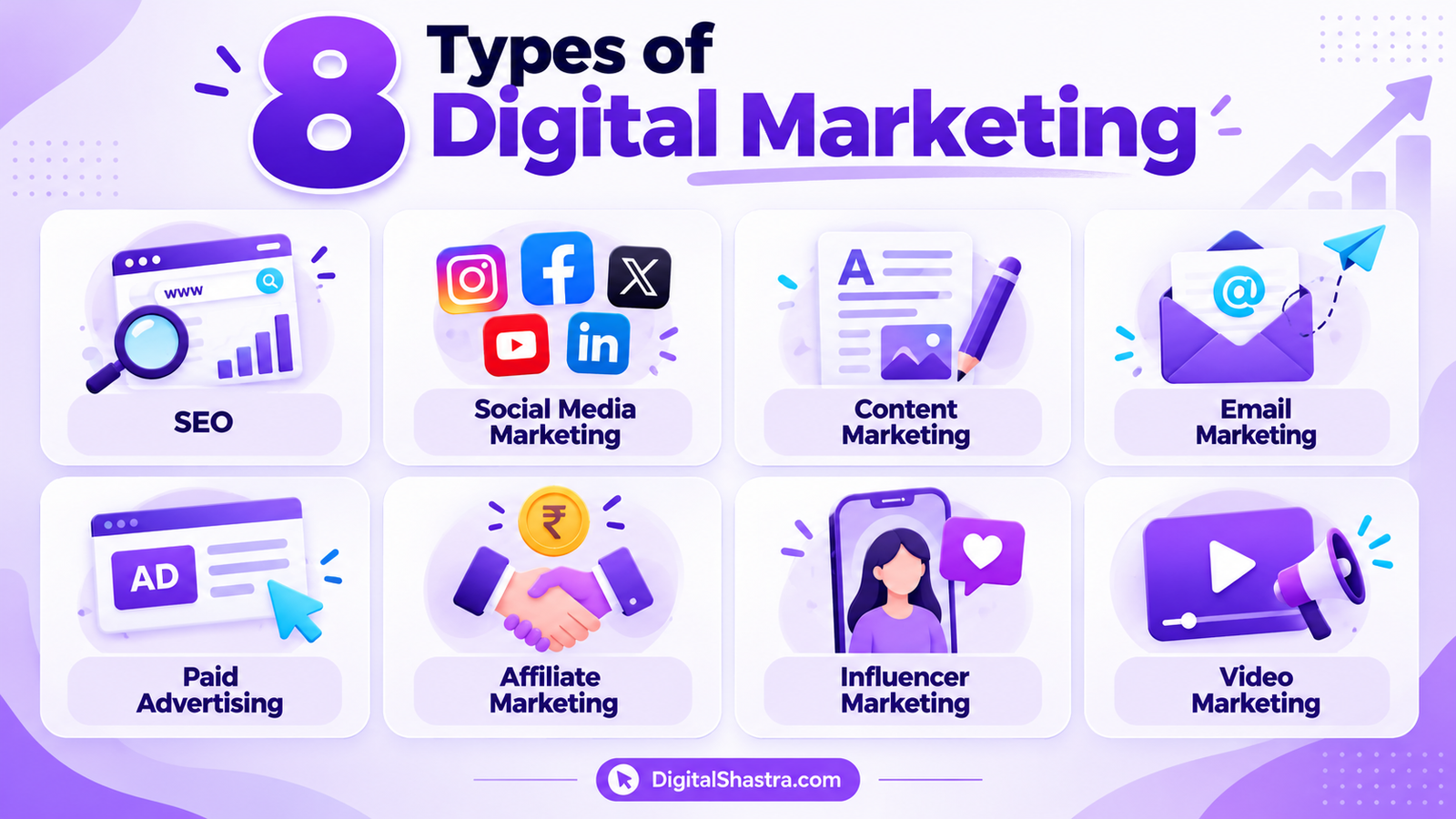
What Are the Main Types of Digital Marketing?
Digital marketing includes several specializations. Each serves a different purpose, and you don’t need to master all of them before getting started.
1. Search Engine Optimization (SEO)
Search engine optimization, or SEO, focuses on helping search engines discover, understand, and appropriately present website content in unpaid search results.
Imagine you’ve created a website offering WordPress tutorials. Someone searches Google for “how to create a WordPress website.”
If your article answers the question clearly and your website meets relevant technical requirements, the page may appear in the search results.
SEO involves much more than inserting keywords into paragraphs.
It includes understanding search intent, creating useful content, improving page titles, organizing website pages, adding relevant internal links, and addressing technical issues that affect crawling and indexing.
Important areas of SEO include:
- Keyword research: Understanding what people search for.
- On-page SEO: Improving page titles, headings, content, and internal links.
- Technical SEO: Addressing crawling, indexing, and website structure issues.
- Content strategy: Planning useful articles around audience needs.
- Local SEO: Helping eligible businesses become more visible in relevant local searches.
For beginners, a sensible starting point is to create one helpful article, make it easy to navigate, and learn how search engines discover its content.
SEO requires patience. Publishing an article doesn’t guarantee that it will rank on the first page of Google. (What Is Digital Marketing)
2. Social Media Marketing
Social media marketing involves using platforms such as Instagram, Facebook, LinkedIn, Pinterest, and YouTube to communicate with an audience and promote a brand.
Businesses may publish educational posts, product demonstrations, short videos, customer stories, and behind-the-scenes content.
However, effective social media marketing isn’t simply about publishing as many posts as possible.
You need to understand what your audience finds useful and which content formats suit your goals.
For example, a website designer could share short website improvement tips, explain common design mistakes, and show examples of completed projects.
These posts demonstrate knowledge and help potential customers understand the services being offered.
Social media can also support customer conversations, community building, and brand recognition. (What Is Digital Marketing)
The goal isn’t just to get attention. It’s to reach the right audience and give people a reason to engage with your brand.
3. Content Marketing
Content marketing focuses on creating and distributing relevant, useful content to attract and retain an audience.
Common formats include blog articles, tutorials, videos, newsletters, podcasts, and downloadable guides.
Consider a website selling gardening supplies. Instead of publishing only product advertisements, it could create articles explaining how to grow vegetables in small spaces, choose suitable pots, and care for indoor plants.
Someone searching for gardening advice might discover one of these articles. If the information is helpful, the reader may return later or explore the site’s products.
For a learning website such as Digital Shastra, content marketing could involve publishing practical tutorials about AI tools, WordPress, SEO, and website creation.
Related articles can help readers explore a topic in greater depth, while internal links make it easier to navigate between useful resources. (What Is Digital Marketing)
4. Paid Advertising
Paid advertising allows businesses to pay for promotional placements across digital platforms.
Google Ads is one familiar example. Businesses can create campaigns that may display advertisements to people searching for relevant products or services.
Social media platforms also offer advertising systems that help businesses reach selected audiences.
PPC stands for pay-per-click, a model in which advertisers generally pay when someone clicks an advertisement. Other advertising campaigns may charge based on impressions or different actions.
Paid campaigns can help businesses reach people without waiting for organic visibility to develop.
However, paying for traffic doesn’t automatically make that traffic valuable.
If an advertisement makes a promise that the landing page doesn’t deliver, visitors may leave without taking action.
Before spending money, establish your objective, define your audience, prepare a relevant landing page, and set a budget you can afford to test. (What Is Digital Marketing)
5. Email Marketing
Email marketing allows businesses to communicate with people who have agreed to receive their messages.
For example, an educational website might offer a free beginner’s guide. People who subscribe could receive additional tutorials, learning resources, and updates about new courses.
Email gives businesses a direct communication channel that doesn’t depend entirely on how frequently social media platforms display their posts.
It works best when messages are relevant and subscribers have a genuine reason to receive them.
Respect consent, protect subscriber information, and provide a clear way for recipients to unsubscribe. (What Is Digital Marketing)
6. Affiliate Marketing
Affiliate marketing is a model in which a person or publisher promotes another company’s products or services and may earn a commission when qualifying actions occur through a referral.
For example, a blogger who writes about website creation might review a hosting service and include an affiliate link.
If a reader makes an eligible purchase through that link, the blogger may receive a commission under the programme’s terms.
Affiliate marketing can work with blogs, videos, newsletters, and other content formats.
The important thing is to recommend products responsibly. Explain relevant limitations, avoid unsupported promises, and disclose affiliate relationships clearly. (What Is Digital Marketing)
7. Influencer Marketing
Influencer marketing involves collaborating with creators who have established audiences around particular interests, professions, or types of content.
A business might work with a food creator to demonstrate a kitchen product or collaborate with a technology reviewer to introduce a new device.
A creator doesn’t necessarily need millions of followers to be relevant. Someone with a smaller, engaged audience that matches the intended customers may also be a suitable partner.
Businesses should consider audience relevance, credibility, campaign objectives, and costs when evaluating collaborations.
Sponsored content should be disclosed appropriately so viewers understand the commercial relationship. (What Is Digital Marketing)
8. Video Marketing
Video marketing uses videos to explain ideas, demonstrate products, promote services, or build an audience.
Common formats include YouTube tutorials, Instagram Reels, product demonstrations, educational shorts, and webinars.
For example, a beginner learning WordPress could record a screen tutorial showing how to create a page using Elementor.
A video makes it possible to demonstrate a process visually instead of relying entirely on written instructions.
You don’t always need expensive equipment. A clear explanation, readable screen recording, understandable audio, and useful subject matter can be enough to begin. (What Is Digital Marketing)
Digital Marketing vs Traditional Marketing
Traditional marketing includes channels such as newspapers, television, radio, billboards, and printed materials. Digital marketing uses websites, search engines, social media, email, and other digital platforms.
Both can be useful, depending on the business and its audience.
| Factor | Digital Marketing | Traditional Marketing |
|---|---|---|
| Common channels | Websites, search, social media, email | Newspapers, television, radio, print |
| Audience reach | Local, national, or international | Depends on the medium and placement |
| Budget | Some activities can start at low cost | Costs vary by channel |
| Measurement | Often uses clicks, conversions, and analytics | May use surveys, reach estimates, and other methods |
| Interaction | Can support direct online conversations | Often relies on indirect or delayed responses |
| Flexibility | Many campaigns can be adjusted during delivery | Some placements require advance production or booking |
Digital marketing isn’t automatically better for every situation.
A local event might benefit from posters and community announcements. A business targeting people searching for a specific service might benefit from SEO or paid search. Some organizations may find that combining traditional and digital methods works best.
The right choice depends on the audience, objective, and available budget. (What Is Digital Marketing)

Which Digital Marketing Skills Should Beginners Learn?
If you’re just starting, the number of available tools and techniques can feel overwhelming.
You don’t need to learn everything simultaneously. Start with skills that help you understand how marketing works, then develop deeper expertise in areas that interest you.
Communication and Writing
Marketing involves explaining why something matters to a particular audience.
Practise writing clear introductions, helpful explanations, product descriptions, social media captions, and calls to action.
You don’t need complicated vocabulary. In many situations, straightforward language that answers a question is more useful than impressive-sounding sentences that say very little. (What Is Digital Marketing)
Research and Audience Understanding
Learn how to investigate a topic before creating content.
Read relevant documentation, compare products, explore the questions people ask, and distinguish reliable information from unsupported claims.
Understanding your audience matters just as much. A tutorial for someone who has never built a website should not assume the same knowledge as a guide written for an experienced developer. (What Is Digital Marketing)
Basic SEO
Learn how search engines discover content and how to organize a website around visitors’ needs.
Practise researching topics, writing descriptive titles, creating useful headings, adding internal links, and checking whether pages work well on mobile devices.

Content Creation
Experiment with writing articles, creating graphics, recording videos, and preparing educational posts.
Tools such as Canva can help you create visuals, but the tool itself isn’t the whole skill. The usefulness of the idea and the clarity of the message matter just as much.
Website Management
Learn how a website is organized, how pages are created, and how visitors move from one page to another.
WordPress is one option for practising website management. A visual page builder such as Elementor can help you experiment with layouts without writing all the code yourself. (What Is Digital Marketing)
Analytics and Measurement
Understand what common metrics mean and why they matter.
Impressions describe how often content is displayed in a particular reporting context. Clicks record interactions that lead users to a destination. Conversion rate measures the proportion of relevant visitors or interactions that complete a defined action, depending on how the metric is configured.
These numbers become more useful when connected to a clear objective. (What Is Digital Marketing)
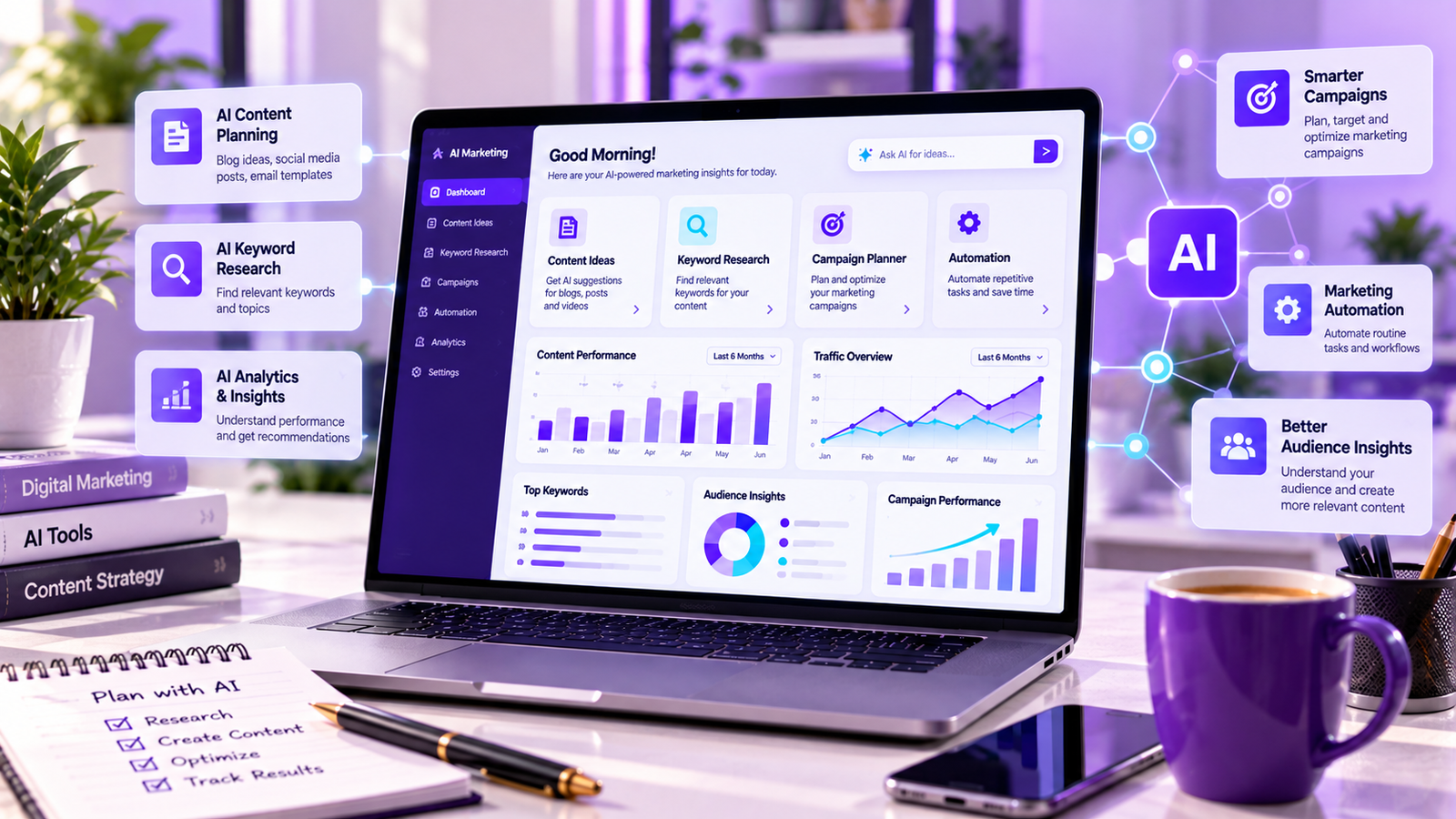
Working With AI Tools
AI tools can assist with brainstorming, outlining articles, planning content, and speeding up selected repetitive tasks.
However, AI-generated output can contain inaccurate statements, generic explanations, and recommendations that don’t fit your situation.
Use AI as an assistant rather than treating every answer as correct. Verify important facts, add relevant examples, and make sure the final content reflects your own judgment. (What Is Digital Marketing)

Useful Digital Marketing Tools for Beginners
You don’t need a large collection of subscriptions to start learning. A small set of tools is usually enough for an initial project.
Google Search Console: Helps website owners understand how their pages perform in Google Search and identify certain search-related issues.
Google Analytics: Helps analyze website activity and evaluate configured events or conversions.
Google Trends: Allows you to explore changes in search interest across topics and regions.
WordPress: Provides a way to create and manage websites, blogs, and other online content.
Elementor: A visual page builder for WordPress that can help you design website pages.
Canva: Useful for creating graphics, presentations, social media posts, and other visual content.
Google Ads: Used to create and manage advertising campaigns across Google’s advertising network.
Meta Business Suite: Supports management of eligible Facebook and Instagram business activities.
ChatGPT: Can assist with brainstorming, outlines, content planning, and explanations of unfamiliar concepts.
Mailchimp: An option for managing email marketing activities.
Features, eligibility, and pricing can change, so check official documentation before relying on a particular feature.
For a first project, you might only need WordPress, Canva, Google Search Console, and an appropriate analytics setup. Add other tools when your project actually needs them. (What Is Digital Marketing)
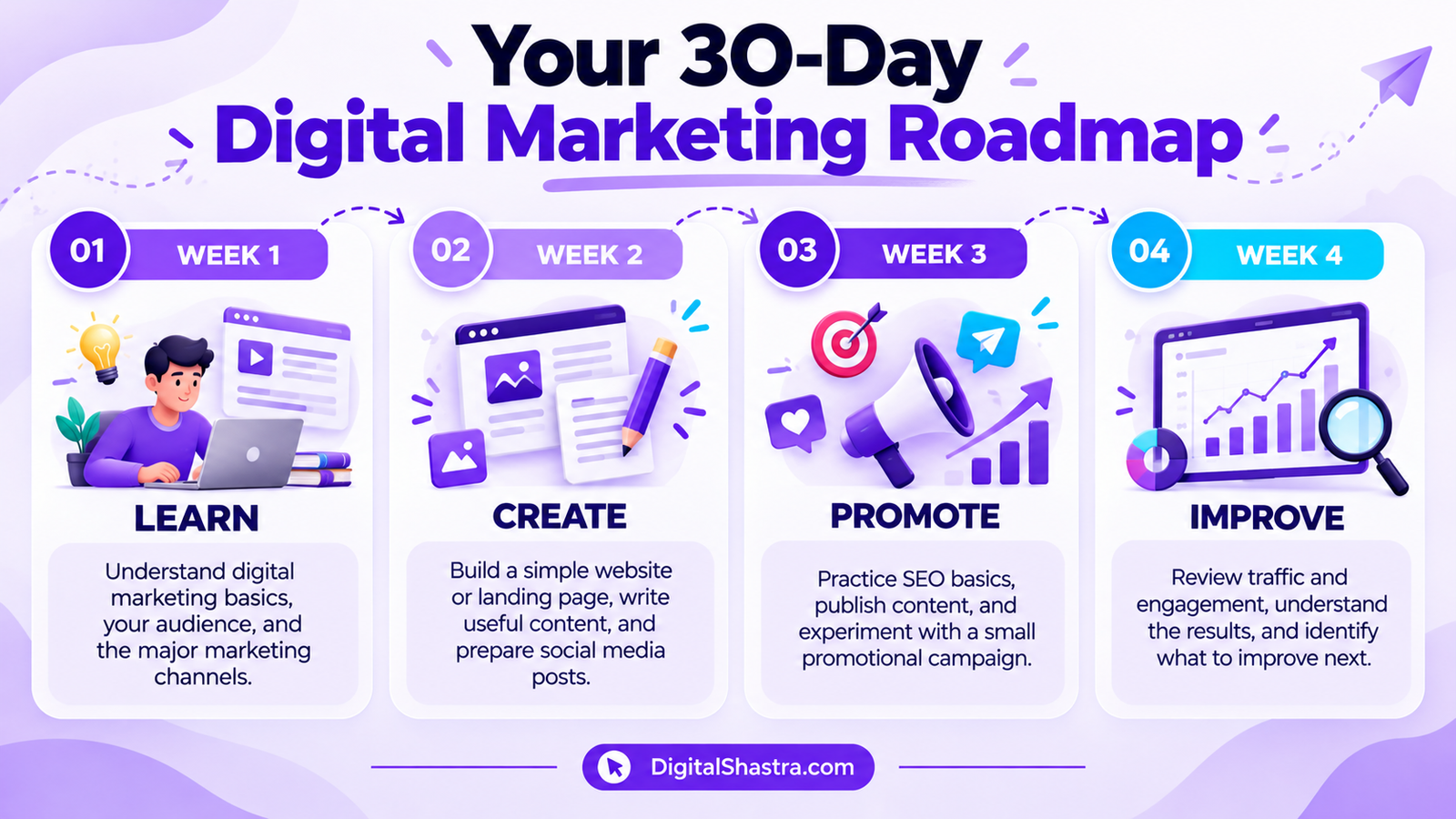
How to Learn Digital Marketing From Scratch: A 30-Day Plan
Reading about digital marketing is useful, but practising it helps you understand how the different parts work together.
Use this four-week plan as an introduction. It isn’t a promise that you’ll become a professional in 30 days; the goal is to build a foundation and complete a small project. (What Is Digital Marketing)
Week 1: Learn the Fundamentals
Spend the first week understanding SEO, content marketing, social media, email, and paid advertising.
You don’t need to memorize every definition. Focus on understanding what each channel does and which problems it can help solve.
Choose a topic for a practice project. It could be a personal blog, a portfolio website, a small online store, or an educational social media page.
Write down three things:
- Who might be interested in your project?
- What problem or need does it address?
- What would you like visitors to do?
These answers will guide your decisions. (What Is Digital Marketing)
Week 2: Create Something Useful
Start building your project.
If you’re creating a blog, publish a helpful article. If you’re practising social media marketing, prepare several posts around one clear topic. If you’re learning website design, build a homepage that explains what the website offers.
Pay attention to readability, navigation, and whether the content actually helps the intended audience.
Don’t spend the entire week adjusting small design details while leaving the main content unfinished.
Your goal is to create something real that you can evaluate and improve. (What Is Digital Marketing)
Week 3: Learn How People Discover Your Work
Explore the channels that fit your project.
For a blog, this could mean researching relevant search topics, writing descriptive page titles, organizing headings, and linking related articles.
For a social media page, you could test different content formats and study which topics generate meaningful engagement.
For a local business, you might improve its online information and make contact details easier to find.
Choose one or two approaches instead of attempting everything at once. (What Is Digital Marketing)
Week 4: Measure, Learn, and Improve
Review what you’ve created.
Are people finding your content? Is the information easy to understand? Are visitors taking the action you intended? What could you improve?
A new website might receive very little traffic during its first month. That doesn’t automatically mean the project has failed.
You can still check whether the website is accessible, whether the content answers the intended question, and whether its pages are organized clearly.
Use the information available to decide what to do next. Continue practising after the first month and develop the skills your project requires. (What Is Digital Marketing)
Can You Earn Money With Digital Marketing?
Digital marketing skills can support several career paths and business models. Results depend on your ability, experience, portfolio, and the opportunities available to you.
Freelancing
Freelancers provide services to businesses or individuals.
Depending on their skills, they might offer SEO support, blog writing, social media management, website creation, or advertising campaign management.
If you want to freelance, begin by choosing a service you can deliver competently. Create sample work, document your process, and practise explaining how your service could help a client.
You don’t need to offer every service from the beginning. (What Is Digital Marketing)
Working With a Company or Agency
Businesses employ people in different marketing roles, including SEO, content creation, performance marketing, social media, and marketing analytics.
Some positions are suitable for beginners, while others require substantial practical experience.
A portfolio showing what you can do may help employers evaluate your abilities more clearly than a list of tools you’ve watched tutorials about. (What Is Digital Marketing)
Building Your Own Business
If you already sell products or services, digital marketing can help you attract potential customers and understand their needs.
You could build a website, publish educational content, improve local search visibility, or test advertising campaigns.
The objective is to connect marketing activities to business results rather than collecting views without understanding their value. (What Is Digital Marketing)
Creating Educational Content
You can also use digital marketing skills to grow a blog, YouTube channel, or educational platform.
Over time, a suitable audience may create opportunities for advertising revenue, sponsorships, affiliate commissions, services, or digital products.
These outcomes aren’t guaranteed. They generally require consistent work, useful content, and an understanding of relevant platform rules.
The best starting point is to develop a skill you can demonstrate. Don’t choose a career path solely because someone online claims it produces quick or effortless income. (What Is Digital Marketing)
Common Digital Marketing Mistakes Beginners Should Avoid
Trying to Learn Everything at Once
Focus on one main skill and one practical project before adding more complexity. You’ll learn more from applying a skill than from collecting endless lists of tools. (What Is Digital Marketing)
Copying Other Websites Word for Word
Researching competitors can help you understand a topic, but copying their content doesn’t give readers a reason to choose your website.
Develop your own explanations, examples, and practical insights.
Expecting Instant Results
Search visibility, audience trust, and marketing experience usually take time to develop. A lack of immediate results doesn’t necessarily mean that your approach is wrong, but it does mean you should review what can be improved. (What Is Digital Marketing)
Using AI Without Checking Its Output
AI-generated text can sound convincing even when some details are incorrect. Verify factual claims, product information, statistics, and recommendations before publishing.
Focusing Only on Views and Likes
These metrics can be useful, but their meaning depends on your goal. A smaller audience that takes relevant action may be more valuable than a large audience with no interest in your offering. (What Is Digital Marketing)
Spending Money Before Understanding the Basics
Expensive tools and advertising won’t automatically solve problems involving weak content, unclear messaging, or an unsuitable audience.
Learn the fundamentals before committing to significant spending. (What Is Digital Marketing)
Ignoring the Visitor’s Experience
A website should be readable on mobile devices, easy to navigate, and clear about what visitors can do next.
If the page is confusing or difficult to use, visitors may leave even when the content initially attracted them. (What Is Digital Marketing)

How Is AI Changing Digital Marketing in 2026?
AI tools have made some marketing tasks faster and more accessible.
A marketer can use AI to brainstorm article ideas, organize an outline, generate initial design concepts, summarize research materials, or explore different versions of an advertisement.
For beginners, this can reduce the time spent getting started with an unfamiliar task. (What Is Digital Marketing)
However, AI-generated output still requires human judgment.
Imagine asking an AI tool to write a product description. It might produce fluent sentences, but it could also invent product features or describe benefits the product doesn’t provide.
The same problem can occur with blog articles. An article might sound polished while offering little original information or repeating the same points in different words.
That’s why understanding the subject remains important.
Use AI to assist with the work, then review the output, verify important facts, and improve it with relevant examples and explanations.
It’s also worth learning how to work with real data. AI may help interpret a report, but you still need to understand what the numbers measure and whether the conclusions make sense.
The strongest approach is to combine useful tools with clear thinking, research, creativity, and an understanding of your audience. (What Is Digital Marketing)
Frequently Asked Questions About Digital Marketing
Is Digital Marketing Easy to Learn?
The fundamentals are accessible to beginners, but becoming good at digital marketing takes practice. Understanding what SEO and social media marketing do is relatively straightforward. Learning how to build campaigns, evaluate results, and improve performance takes longer. (What Is Digital Marketing)
Can I Learn Digital Marketing Without Coding?
Yes. Many marketing activities don’t require programming knowledge. You can learn content creation, social media management, keyword research, and many advertising tasks without becoming a developer.
Basic HTML and technical knowledge can still be helpful for certain website and SEO tasks. (What Is Digital Marketing)
How Long Does It Take to Learn Digital Marketing?
You can learn the fundamentals within a few weeks of focused study. Developing practical proficiency generally requires additional months of experimentation and real projects. The time needed depends on the skills you’re learning and how consistently you practise. (What Is Digital Marketing)
Can Students Learn Digital Marketing?
Yes. Students can start by creating a blog, managing a practice social media page, learning website design, or building a small portfolio. These projects help them understand the work involved before choosing a specialization. (What Is Digital Marketing)
Is Digital Marketing a Good Career in India?
Digital marketing offers opportunities in companies, agencies, startups, and freelance work. Demand varies by specialization, location, experience, and market conditions. Developing practical skills and demonstrating your work can help you explore relevant opportunities. (What Is Digital Marketing)
What Is the Difference Between SEO and Digital Marketing?
SEO is one part of digital marketing. It focuses on improving a website’s visibility in unpaid search results. Digital marketing is the broader field, covering SEO alongside social media, email, paid advertising, content marketing, and other channels. (What Is Digital Marketing)
Do I Need Paid Tools to Start?
No. Many beginners can start with free learning resources and tools. Paid subscriptions may become useful as projects grow, but it’s sensible to understand your requirements before spending money.
Can AI Replace Digital Marketers?
AI can assist with research, drafting, analysis, and repetitive tasks, but marketing also involves understanding customers, making strategic choices, checking information, and taking responsibility for decisions.
The tools may change, so learning adaptable skills is more useful than depending entirely on one platform. (What Is Digital Marketing)
Final Thoughts: Start Small and Learn by Doing
Digital marketing can look complicated when you first encounter its different channels, tools, and techniques.
The easiest way to approach it is to stop thinking of it as one enormous subject and start treating it as a collection of skills you can learn one at a time.
You could begin with SEO, experiment with social media content, build a simple website, or learn how to create useful videos. As your experience grows, you’ll start understanding how these activities support one another.
Don’t worry about having the perfect setup on your first day. Start with a manageable project, publish something useful, and pay attention to what you learn from the process.
If you’re a student, that project could become the beginning of your portfolio. If you own a business, it could help you understand your customers better. If you’re interested in freelancing, it could give you an example of your work to show potential clients.
There is no single path that works for everyone. What matters is developing skills you can actually use.
At Digital Shastra, we’re here to make digital skills easier to understand through practical tutorials, straightforward explanations, and useful resources. Whether you’re exploring AI tools, learning SEO, building your first WordPress website, or experimenting with content creation, our aim is to help you move from understanding an idea to putting it into practice. (What Is Digital Marketing)
Choose one skill. Start learning. Give yourself room to improve.
Your first project doesn’t have to be perfect. It just has to be a beginning.